
Quick Answer: The best commercial roof for an NYC building depends on roof size, deck type, drainage, rooftop equipment, foot traffic, energy goals, contaminants, and maintenance expectations. TPO, EPDM, modified bitumen, and PVC can all perform well when the complete assembly is professionally designed, installed, inspected, and maintained.
Reliable commercial roofing protects NYC businesses, employees, tenants, equipment, inventory, records, and daily operations.A roofing failure can damage more than ceilings. Water may reach electrical systems, insulation, structural decking, merchandise, machinery, or occupied spaces.
Flat and low-slope roofs dominate many New York City commercial buildings because they work efficiently with broad building footprints and can accommodate HVAC systems, vents, solar arrays, service walkways, and other equipment. These roofs still require positive drainage, compatible materials, carefully constructed flashing, and controlled rooftop access.
The right commercial flat roofing system must withstand seasonal weather, repeated service traffic, wind pressure, ultraviolet exposure, and movement around penetrations. It must also comply with applicable NYC building, energy, drainage, fire, permit, and safety requirements.
This guide compares major commercial roof systems, explains common repairs, outlines preventive maintenance, and examines roofing needs for Brooklyn mixed-use properties, Manhattan high-rises, and Queens industrial facilities.
Why Commercial Roofing in NYC Requires Specialized Roofing Systems
Commercial roofs differ from ordinary residential roofs in scale, use, access, drainage, equipment, and construction. Selecting a membrane only by price or appearance can overlook conditions that determine how the roof will perform.
Unique Challenges of NYC Commercial Buildings
NYC commercial properties range from neighborhood stores and attached mixed-use buildings to warehouses, offices, schools, healthcare facilities, restaurants, and high-rise towers. Each building creates a different roofing environment.
A Brooklyn retail building may contain grease exhaust, skylights, party-wall transitions, and several roof levels. A Manhattan office property may have mechanical equipment, cooling systems, antennas, window-washing supports, and limited access. A Queens warehouse may have a very large deck with widely spaced drains and long membrane seams.
Access can significantly affect installation. Materials may need to be lifted by crane, moved through occupied spaces, or delivered within restricted street-use periods. Contractors may also need public protection, controlled loading areas, temporary barriers, or coordination with tenants.
These conditions make system design as important as membrane selection. Insulation, cover board, vapor control, fastening, drainage, perimeter attachment, flashing, and staging should be planned as one assembly.
Weather, Foot Traffic, and Building Code Requirements
Commercial roofs experience rain, snow, ice, heat, wind, and repeated seasonal movement. Water collects around drains, equipment curbs, parapets, and low areas when the roof lacks adequate slope or drainage maintenance.
Foot traffic adds another risk. HVAC technicians, electricians, plumbers, solar contractors, sign installers, and building staff may cross the roof regularly. Tools, metal panels, fasteners, grease, and equipment supports can puncture or weaken an unprotected membrane.
A high-compressive-strength cover board beneath a single-ply membrane can improve resistance to punctures, hail, foot traffic, and certain wind-uplift stresses. However, the complete roof assembly must be evaluated because adding one strong component does not correct weak flashing or inadequate attachment.
NYC requirements may also involve structural loading, approved materials, insulation, fire performance, storm drainage, emergency overflow, construction safeguards, and inspections. The 2025 NYC Energy Conservation Code has applied to qualifying filings since March 30, 2026.
Why Choosing the Right Commercial Roofing System Matters
The membrane must match the building’s use. A reflective TPO roof may suit an office or warehouse with significant cooling demand. EPDM may provide a practical option where flexibility and proven low-slope performance are priorities. Modified bitumen can support buildings with frequent service traffic, while PVC may be selected where restaurant grease or certain chemical exposures are expected.
Selection also affects repairability, installation method, energy performance, warranty eligibility, and replacement planning.
A roofing system should therefore be chosen after evaluating:
- Roof deck type and structural condition
- Existing roofing layers and trapped moisture
- Drain locations, slope, scuppers, and overflow drainage
- HVAC units, skylights, vents, solar equipment, and penetrations
- Foot traffic, chemical exposure, and anticipated rooftop work
- Insulation, energy goals, fire requirements, and project budget
- Installation access and the building’s operating schedule
The most expensive membrane is not automatically the best. The correct system is the one that addresses the property’s actual risks and can be maintained throughout its service life.
Best Commercial Flat Roofing Systems for NYC Buildings
TPO, EPDM, modified bitumen, and PVC are among the most common choices for low-slope commercial buildings. Each provides different strengths, and none should be installed without compatible insulation, flashing, drainage, and attachment details.
| Roofing system | Main advantage | Common NYC application | Important consideration |
| TPO | Reflectivity and heat-welded seams | Offices, retail buildings, apartments, warehouses | Weld quality and puncture protection |
| EPDM | Flexibility and established field performance | Offices, schools, multifamily and institutional roofs | Seams and flashing require compatible tapes and adhesives |
| Modified bitumen | Reinforced layered construction | Smaller commercial roofs and high-traffic areas | Installation method and asphalt compatibility |
| PVC | Resistance to grease and several contaminants | Restaurants, food facilities, industrial properties | Chemical compatibility and specialized welding |
TPO Commercial Roofing for Energy Efficiency
TPO is a reinforced thermoplastic membrane installed in mechanically attached, fully adhered, or other approved assemblies. Adjoining sheets and accessories are typically fused through controlled hot-air welding.
White TPO reflects a significant portion of solar radiation and can reduce roof-surface heat absorption. This may support cooling efficiency on broad, sun-exposed roofs, although actual energy savings still depend on insulation, HVAC performance, air leakage, roof area, occupancy, and building use.
TPO is widely used for commercial low-slope roofing and is available in multiple thicknesses, reinforcement options, attachment methods, and colors. Carlisle identifies reflectivity, heat and ultraviolet resistance, and energy performance among the principal characteristics of its TPO systems.
The quality of welded seams is critical. Dirt, moisture, incorrect equipment settings, rushed work, or insufficient testing can create weak laps. TPO also benefits from walkway protection and cover boards around mechanical equipment and frequently used access routes.
EPDM Roofing for Long-Term Durability
EPDM is a flexible synthetic rubber membrane used in fully adhered, mechanically attached, and ballasted assemblies. Large sheets may reduce the number of field seams across open roof areas.
Traditional black EPDM absorbs heat, while white EPDM products are available when reflectivity is a project goal. Black membrane may provide different thermal behavior during colder seasons, but the decision should be based on annual building performance rather than membrane color alone.
Seams and flashing are generally formed with compatible primers, tapes, adhesives, molded components, and pressure-sensitive accessories. Proper surface preparation is essential because contamination can prevent reliable bonding.
EPDM can perform well on offices, schools, multifamily properties, and institutional buildings. Its flexibility can accommodate some building movement, but it still requires sound perimeter attachment, protected traffic routes, clear drainage, and properly supported flashing.
Modified Bitumen Roofing for Heavy Foot Traffic
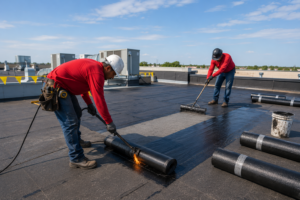
Modified bitumen is an asphalt-based roofing material reinforced with polyester, fiberglass, or another carrier. Systems may use SBS or APP membranes installed with hot asphalt, torch application, cold adhesive, mechanical fastening, or self-adhering technology.
Its layered construction provides redundancy. If the surface is damaged, additional reinforced plies may continue protecting the assembly until repairs are completed. Asphaltic systems can also offer useful puncture resistance and durability where maintenance traffic is expected.
Modified bitumen is often practical on smaller commercial roofs containing parapets, skylights, curbs, hatches, and complicated flashing. Granulated cap sheets can withstand routine service traffic better than many exposed lightweight membranes, although designated walkways are still advisable.
Torch installation involves open-flame hazards and must be completed by trained professionals using appropriate fire-prevention procedures. Cold-applied and self-adhering systems may be considered where occupied-building conditions make torch work unsuitable.
PVC Roofing Systems for Restaurants and Industrial Buildings
PVC is a reinforced thermoplastic membrane with seams joined through hot-air welding. Like TPO, it is available in reflective colors and can be installed through several attachment methods.
A key PVC advantage is resistance to many chemicals, oils, grease, and animal fats. This makes compatible PVC assemblies a common consideration for restaurants, food-processing areas, and selected industrial buildings where exhaust can contaminate the roof.
Resistance is still product specific. The concentration, temperature, duration, and type of exposure must be considered. Exhaust should also be discharged, captured, and maintained properly rather than relying on the membrane to absorb unlimited contamination.
PVC seams, coated-metal details, drains, curbs, and penetrations require experienced installers. Incompatible asphalt, adhesives, sealants, or older roof materials may need an approved separation layer.
Commercial Roof Repair in NYC: Common Problems Businesses Face
Commercial roof repairs should address both the visible defect and the conditions that caused it. Repeated surface patches often fail when drainage, wet insulation, movement, or equipment details remain unchanged.
Roof Leaks Around HVAC Units and Skylights
HVAC units create several leak risks. Curbs, pipes, ducts, conduits, supports, and service panels interrupt the roof and require individual waterproofing details.
Service technicians may also drop tools or remove panels, while condensation lines and equipment discharge can keep surrounding areas wet. Unsupported pipes can move, and curb flashing can separate when equipment vibrates.
Skylights may leak through damaged glazing, curb flashing, fasteners, condensation, or blocked internal drainage channels. Their location should be inspected from the roof and interior before repairs are recommended.
A dependable commercial roof repair contractor in NYC should identify whether water is entering through the membrane, flashing, equipment, glazing, ductwork, or condensation. Sealing the nearest visible joint without confirming the source may not stop the leak.
Ponding Water on Flat Commercial Roofs
Ponding develops where water remains after surrounding areas have drained. Causes include blocked outlets, compressed insulation, structural deflection, inadequate slope, high drain flanges, or equipment that interrupts flow.
Water may not penetrate an intact membrane immediately, but prolonged exposure increases pressure on seams, flashing, punctures, and aging repairs. It also collects dirt and can make service areas slippery.
The response depends on the cause. Clearing a drain may solve one problem, while another roof may require tapered insulation, crickets, additional outlets, drain adjustment, or structural evaluation.
NYC roofs enclosed by parapets may require secondary drains or overflow scuppers so a blocked primary system cannot allow unsafe water accumulation.
Membrane Damage and Flashing Failures
Common membrane problems include punctures, open seams, cuts, blisters, cracks, shrinkage, worn coatings, and incompatible patches.
Flashing failures occur around parapets, drains, pipes, curbs, walls, hatches, and roof edges. These areas move differently from the open roof field and are frequently affected by service traffic.
The repair material must match the existing roof. EPDM uses rubber-compatible primers, tapes, and patches. TPO and PVC generally use heat-welded thermoplastic details. Modified bitumen requires asphalt-compatible membranes and flashing materials.
Wet insulation should be removed rather than sealed beneath the patch. A repair over saturated material may hide continuing damage and reduce thermal performance.
Storm and Wind Damage on Commercial Roofs
High winds can loosen perimeter metal, coping, membrane terminations, flashing, equipment covers, and older patches. Damage often begins at corners and edges where wind pressure is concentrated.
Debris may puncture the roof or damage rooftop equipment. Heavy rain can then exploit openings that were not leaking before the storm.
After severe weather, building staff should document visible damage from safe locations and restrict roof access. NRCA recommends that close storm-damage assessment and repairs be performed by professional roofing contractors.
Commercial Roof Maintenance for NYC Office Buildings, Warehouses, and Retail Properties
A written maintenance program helps property managers address small defects before they interrupt building operations.
Seasonal Roof Inspection Checklist
Industry guidance recommends inspections twice each year and after severe weather, commonly during spring and fall.
A seasonal inspection should review:
Spring
- Winter damage, open seams, displaced flashing, and freeze-related movement
- Drains, scuppers, gutters, downspouts, and low areas
- Interior stains or leaks that appeared during snowmelt
Fall
- Leaves, branches, grease, and surface debris
- Coping, perimeter metal, roof hatches, and equipment supports
- Repairs needed before snow, ice, and freezing temperatures
Additional inspections should follow severe storms, major HVAC service, solar work, masonry repairs, or any project that brings another contractor onto the roof.
Preventive Maintenance That Reduces Repair Costs
Roof maintenance is one of the most important factors, after proper installation, in determining system lifespan and overall cost.
Preventive work can include localized seam repairs, flashing reinforcement, replacement of damaged walkway pads, drain cleaning, coating touch-ups, and removal of abandoned equipment or fasteners.
The maintenance plan should rank conditions by urgency. Active openings, unstable metal, saturated areas, and electrical hazards require prompt attention. Cosmetic staining or stable surface wear may be monitored.
A roof plan showing drains, equipment, repairs, and previous leaks helps contractors identify recurring patterns.
Cleaning Drains, Gutters, and Roof Surfaces
Commercial roofs should remain free of leaves, branches, grease, packaging, bottles, fasteners, membrane scraps, and construction material.
Strainer domes must remain secured over interior drains. Debris should be removed from the roof rather than pushed into the conductor. Slow drainage after surface cleaning may indicate a blockage within the pipe.
Gutters, collector heads, and downspouts should remain attached and unobstructed. Water should not overflow against façades, entrances, loading areas, foundations, or adjoining property.
Maintaining Roofing Around Rooftop Equipment
Walkways should connect roof access points to equipment that requires regular service. Technicians should use these routes rather than crossing unsupported membrane areas.
Pipes, conduits, ducts, and equipment should rest on approved supports. Wood blocks, bricks, and sharp metal placed directly on the membrane can damage the roof and obstruct drainage.
New equipment should not be installed without coordinating its weight, attachments, curbs, wiring, drainage, and flashing. NYC may require structural review and special inspections for equipment mounted to rooftop steel or dunnage.
Commercial Roofing Solutions for Brooklyn Businesses
Brooklyn contains attached stores, restaurants, warehouses, manufacturing buildings, offices, apartment-and-retail properties, and converted industrial spaces. Their roofs frequently combine several construction periods and uses.
Roofing Challenges for Mixed-Use Commercial Buildings
Mixed-use buildings often have occupied apartments above or beside commercial spaces. Roofing work must therefore control noise, odor, dust, temporary openings, tenant access, and interior protection.
Restaurant exhaust may introduce grease, while rear additions and neighboring roof levels create complex flashing and drainage transitions. Party walls, parapets, skylights, hatches, and several generations of repairs are also common.
The roofing plan should reflect the entire building rather than only the area above the business.
Flat Roof Systems for Brooklyn Commercial Properties
TPO and PVC may suit buildings seeking reflective thermoplastic membranes. EPDM can provide a flexible single-ply solution, while modified bitumen may be practical for smaller roofs with heavy service traffic and complicated details.
Roof restoration coatings may be considered when the existing system is dry, stable, securely attached, and compatible. Coating should not be used to conceal wet insulation, widespread seam failure, or deteriorated decking.
Maintenance Tips for Older Commercial Roofs
Older roofs should be inspected for unknown layers, trapped moisture, deck movement, outdated drains, deteriorated parapets, and incompatible repairs.
Before another recover system is added, the contractor should verify existing roof condition, allowable layers, structural loading, insulation, and code requirements.
Commercial owners should also control access by other trades. Every rooftop alteration should be documented and inspected after completion.
Commercial Roofing Services for Manhattan High-Rise Buildings
High-rise roofing involves more than selecting a membrane. Wind exposure, vertical transportation, staging, public protection, equipment density, and safe access can dominate project planning.
Rooftop Equipment and Waterproofing Considerations
Manhattan roofs may contain cooling towers, large HVAC units, exhaust systems, antennas, solar equipment, window-washing supports, and mechanical bulkheads.
Each curb, pipe, duct, and attachment must be integrated with the roof. Equipment replacement should be coordinated with roofing so obsolete curbs are removed and new openings are flashed correctly.
Condensation, chemical discharge, grease, vibration, and maintenance traffic should also be considered during system selection.
High-Rise Roof Access and Safety Requirements
Commercial roofing workers exposed to unprotected low-slope roof edges six feet or more above a lower level generally require an approved fall-protection method under OSHA construction standards. Permitted systems can include guardrails, safety nets, personal fall-arrest systems, and specified warning-line combinations.
High-rise work may also require hoisting plans, controlled material storage, public protection, emergency procedures, and coordination with building management.
Roof access systems, anchors, ladders, hatches, and guardrails should be evaluated before the project starts.
Long-Term Roofing Strategies for Commercial Buildings
A long-term strategy should identify immediate repairs, restoration opportunities, anticipated replacement, capital budgets, warranty conditions, and inspection frequency.
Replacing a roof during a planned capital project gives the owner more control than waiting for widespread leaks. It also allows coordination with insulation upgrades, solar systems, equipment replacement, and drainage corrections.
Choosing the Right Commercial Roofing Contractor
The contractor should be selected for technical capability, safety practices, documentation, and experience with the proposed roof system.
Experience with Flat Roofing Systems
Ask for projects involving the same membrane, deck, building type, roof size, access conditions, and equipment density.
The contractor should explain attachment, seam construction, insulation, cover board, perimeter reinforcement, drainage, flashing, testing, and quality-control procedures.
Manufacturer authorization may support warranty eligibility, but it does not replace local licensing, insurance, or code compliance.
Licensing, Insurance, and Safety Standards
Applicable NYC licensing or registration depends on property type and project scope. Owners can verify DCWP home-improvement licenses and DOB contractor or registrant status through official city searches.
Permit requirements should be identified before work begins. Current NYC rules generally allow limited roof work above the deck to remain permit-exempt under stated conditions, while work involving deck or sheathing replacement requires a permit.
The contractor should also provide suitable insurance, a site-specific safety plan, employee training, and documented fall-protection procedures.
Warranty Coverage and Maintenance Programs
Commercial warranties may include separate coverage for materials, manufacturer system performance, and contractor workmanship.
Owners should review duration, wind limits, ponding-water provisions, excluded contaminants, inspection duties, repair notification, transferability, and maintenance requirements.
A long warranty should not be compared by years alone. Membrane thickness, attachment method, insulation, cover board, approved contractor status, and inspection requirements may differ.
Commercial Roofing for Queens Industrial Facilities and Distribution Centers
Queens contains distribution centers, workshops, manufacturing properties, food facilities, auto-related buildings, and large warehouses. Their roofs often cover substantial areas and support intensive operations.
Durable Roofing Systems for Large Roof Areas
Large roofs benefit from careful drainage zoning, membrane layout, wind design, equipment planning, and moisture investigation.
Mechanically attached single-ply systems can provide efficient installation across broad areas, while adhered or hybrid systems may be selected for specific wind, deck, or performance needs. Attachment must be based on the approved system rather than installation speed alone.
Warehouses with frequent service traffic may benefit from reinforced membranes, cover boards, and clearly marked walkways.
Energy-Efficient Roofing for Warehouses
A reflective TPO, PVC, white EPDM, metal, or compatible coating system may reduce solar heat absorption. The benefit is often most noticeable on broad, exposed buildings with large roof-to-floor-area ratios.
Energy performance still depends on insulation and air control. NYC’s energy code is intended to improve the building envelope, including roofs, so conditioned energy remains inside the building.
Roof replacement planning should therefore examine insulation levels, moisture, air leakage, rooftop equipment, and reflectivity together.
Preventing Business Downtime During Roofing Projects
A phased installation plan can keep loading areas, offices, production zones, and tenant spaces operating safely.
Contractors should coordinate:
- Material delivery and crane or hoisting schedules
- Temporary protection over occupied or sensitive spaces
- Odor, noise, dust, and hot-work restrictions
- Access to HVAC units, fire systems, and emergency routes
- Daily weatherproofing and end-of-shift inspections
- Clear procedures for concealed damage and change orders
For inventory, food, electronics, healthcare, or manufacturing facilities, the contractor should understand the operational consequences of dust, moisture, odor, and accidental shutdowns.
Conclusion: Protect Your NYC Commercial Property with the Right Roofing System
Commercial roofs must protect the building while supporting equipment, drainage, maintenance traffic, energy performance, and ongoing business activity.
The main takeaways include:
- TPO provides reflective performance and heat-welded seams for many offices, warehouses, and retail buildings.
- EPDM offers flexibility and established low-slope performance.
- Modified bitumen provides reinforced layers that can benefit high-traffic and complicated roofs.
- PVC is a strong consideration for restaurants and properties exposed to oils, grease, or certain chemicals.
- Ponding water, damaged flashing, punctures, and equipment curbs are common commercial leak sources.
- Professional spring, fall, and post-storm inspections can identify problems before they disrupt operations.
- Rooftop access should be controlled and designated walkways should protect frequently traveled areas.
- NYC permits, energy requirements, drainage rules, inspections, and OSHA safety standards must be addressed according to the project.
- A qualified contractor should provide system-specific experience, proper insurance, detailed documentation, warranties, and ongoing maintenance options.
Many flat roofing systems provide service lives within a broad range of approximately 15 to 30 years, while some systems perform longer. Actual longevity depends on the membrane, assembly, installation, exposure, drainage, foot traffic, repairs, and maintenance history.
Need reliable commercial roofing services in NYC? Contact Royal Renovators Inc. at (718) 414-6067 or visit 118-35 Queens Blvd, Forest Hills, NY 11375 to schedule a professional commercial roof inspection and receive a customized recommendation for roof repair, preventive maintenance, restoration, or complete flat-roof replacement for your office, retail property, warehouse, apartment building, restaurant, or industrial facility.
FAQs About Commercial Roofing in NYC
What is the best commercial roofing system for buildings in NYC?
The best system depends on the roof deck, drainage, building use, foot traffic, equipment, contaminants, energy goals, budget, and maintenance plan. TPO, EPDM, PVC, and modified bitumen can all provide reliable performance when matched correctly to the property.
How long does a commercial flat roof typically last?
Many commercial flat roofs provide approximately 15 to 30 years of service, while some well-designed systems perform longer. Actual lifespan depends on the membrane, installation quality, insulation, drainage, weather exposure, rooftop traffic, repairs, and maintenance history.
How often should commercial roofs be inspected in NYC?
Commercial roofs should generally be inspected during spring and fall and after severe storms. Additional inspections should follow HVAC work, solar installation, masonry repairs, equipment replacement, or other activity that may affect the roof.
What are the most common causes of commercial roof leaks?
Common causes include membrane punctures, open seams, damaged flashing, blocked drains, ponding water, loose perimeter metal, deteriorated equipment curbs, skylight problems, storm damage, foot traffic, and incompatible previous repairs.
Is TPO commercial roofing a good choice for office buildings?
TPO can be a suitable choice for office buildings because it offers reflective surfaces, heat-welded seams, and several installation options. The roof deck, insulation, drainage, wind design, foot traffic, equipment, and installer experience must still be evaluated.
When should a commercial roof be repaired instead of replaced?
Repair is generally appropriate when damage is localized and the surrounding membrane, insulation, flashing, and deck remain serviceable. Replacement may provide better value when leaks are widespread, insulation is saturated, the deck is deteriorated, or recurring repairs continue to fail.
How can regular roof maintenance reduce commercial roofing costs?
Regular maintenance allows blocked drainage, punctures, open seams, damaged flashing, loose metal, and equipment-related problems to be corrected before water spreads into insulation, decking, ceilings, inventory, or occupied business areas.